











If you believe your social feed, there’s always something else you should be taking, eating or adding to your routine. Superfood powders promise better recovery, electrolytes promise better hydration and supplements promise that elusive extra edge. But how much of it do you actually need?
For nutritionist and author Josie Porter, health and performance starts with the fundamentals: eating enough, getting your fibre fix and matching your macros to your training demands. That doesn’t mean supplements are off the menu – in the right circumstances, some can be genuinely useful. Josie explains what active people really need from their diet, how to fuel and recover effectively, and where supplements can – and can’t – make a difference.
Why have supplements become so popular?
Supplements have been around for a long time, but in the last few years they’ve really exploded. There are a few reasons for that. First, we’re simply being exposed to them far more often. They take up more space on shop shelves and dominate social media feeds, particularly in fitness spaces where products are constantly being promoted for recovery, performance or body composition.
Second, they often tap into our vulnerabilities or the parts of ourselves we want to improve. Whether that’s better sleep, more energy, faster recovery or building muscle, supplements are often marketed as the missing piece.
And finally, there’s the culture of optimisation. In sport and fitness, it’s very easy to feel like there’s always another edge to gain. But while some supplements absolutely have a place, many of the biggest gains still come from the fundamentals: training well, eating well, sleeping well and recovering properly.
How well-regulated is the supplement industry?
Supplements are regulated, but just not like medications. Companies don’t have to prove that a product works before it’s sold, and in many cases they don’t even have to prove the dose on the label matches what’s inside the product.
It also means marketing can sometimes run ahead of the evidence. You’ll often see big claims about recovery, hormones or performance that sound convincing but are based on very limited research.
The takeaway isn’t that supplements are automatically bad. It’s that consumers need to be a little more sceptical and choose products carefully.
Can taking supplements be detrimental to our health?
Supplements are designed to top up gaps, not replace the foundations of health. When people start taking lots of them unnecessarily, they can sometimes work against us rather than for us.
One issue is toxicity, as some can become harmful in high doses. Fat-soluble vitamins like A and D can accumulate in the body, and large doses of minerals like iron can cause problems if you don’t actually need them. More isn’t always better.
Even when taken in safe doses, long supplement stacks can distract people from the basics that make the biggest difference. I often see people investing heavily in pills while their diet, sleep or training recovery still need attention. This can sometimes mask the real issue. For example, taking magnesium for sleep or fatigue might help a little, but if someone is chronically stressed, under-fuelled or not sleeping enough, the supplement is treating the symptom rather than the cause.
 Many active people rely on supplements. Are they necessary?
Supplements became popular in sport because once researchers understood how to correct nutrient deficiencies, the next question was whether certain nutrients could also support performance and recovery. In elite sport, even small advantages can matter, which is why supplements like creatine, electrolytes and beta-alanine have been studied extensively.
Some do have benefits in specific situations. Creatine can support strength and repeated high-intensity bursts of activity, caffeine can improve endurance and alertness, and electrolytes can be useful during long sessions or in hot conditions.
But supplements are very sport- and context-specific. They’re rarely essential. When used correctly, they can make a noticeable difference for some people. In other cases, they can be a convenient way to bridge a gap – think electrolytes after a sweaty session or a protein powder in between meals.
Instead of jumping on every trend, take a step back. Check if you need it, check the evidence, and check what you’re actually getting.
If someone exercises regularly, which nutrients should they focus on getting from food?
Protein is the obvious one, and it does matter around training because it helps repair and build muscle. For many active people, a good starting point is around 1.4g of protein per kilogram of body weight per day, but if gaining muscle is your goal you could start closer to 1.6g per kilogram and work your way up as needed. For many people this works out to roughly 25 to 40g of protein per meal, from foods like yoghurt, eggs, tofu, beans, fish or lean meat.
 But protein isn’t the only nutrient that matters. Carbs help refill your muscle glycogen stores, which power everything from long runs to strength sessions. Without enough of them, recovery slows down and performance can dip. Foods like oats, potatoes, rice, wholegrains and fruit keep those energy stores topped up.
Vitamins and minerals get talked about less in sports nutrition, but they still matter for recovery and performance. Nutrients like iron, calcium, magnesium, potassium and B vitamins support oxygen transport, bone health and energy metabolism. This is one reason why overly restricting food groups can work against you. When you cut out whole categories of foods, you also lose the wider package of nutrients that come with them. Eating a varied diet is one of the simplest ways to cover these bases without relying on supplements.
What are some simple, nutrient-dense recovery meals?
One of my favourite recovery meals is ramen. After a sweaty run or workout, it ticks a lot of boxes. You get carbohydrates from the noodles to refill glycogen stores, protein from toppings like eggs, tofu or chicken to support muscle repair, and the broth naturally contains sodium which helps replace what you lose through sweat.
More broadly, good recovery meals tend to follow a similar formula: carbohydrates, protein and fluids. That could be something simple like rice with soy-glazed salmon and vegetables, my chickpea scrambled egg with everything-but-the-bagel-seasoning on toast (which you can find in my book) or yoghurt with fruit, granola and nut butter if you prefer something sweet.

How about protein bars and shakes?
Protein bars and shakes can absolutely have a place. Like any food, some are great and some are filled with things we probably want to eat a little less of, like added sugars, saturated fats or artificial sweeteners. They’re fine in moderation, but it’s still worth checking what you’re actually buying.
For roughly 15-20g of protein, snacks like a bowl of low-fat Greek yoghurt or Skyr with fruit (lower-fat versions tend to be higher in protein), edamame and egg pots, cottage cheese with crackers, or baked tofu pots all work well.
Instead of jumping on every trend, take a step back. Check if you need it, check the evidence, and check what you’re actually getting.
Let’s talk immunity. How can everyday exercisers support their immune system through diet?
Supporting immunity through diet is less about one “superfood” and more about the overall pattern of how you eat. One of the biggest risks for active people is actually under-fuelling. When training volume goes up but food intake doesn’t keep pace, the body has fewer resources for recovery and immune function can take a hit.
Fruit and vegetables play a big role too. They provide nutrients like vitamin C, carotenoids and polyphenols, alongside fibre that supports the gut-immune connection. Aiming for at least five portions a day, and ideally a good variety across the week, helps give your immune system the tools it needs to respond well to training stress and the bugs we inevitably encounter.
Are there any supplements you think are genuinely useful – or is food always better?
Supplements definitely have their place, particularly when it comes to correcting or preventing deficiencies, such as vitamin B12 in some plant-based diets, or omega-3 for those who don’t eat much fish. Supplementing nutrients like vitamin D, iron and B12 can be important if levels are low, as food alone isn’t always enough to bring them up.
In the sports world, there are a handful of supplements with strong evidence behind them, such as creatine, caffeine, beta-alanine and bicarbonate. That said, these are very context dependent. The benefits tend to be modest and sit on top of a solid foundation of good nutrition, training and recovery. But in a performance setting, those modest gains can be exactly what people are looking for.
What is the biggest nutrition myth you see on social media?
One I see a lot is around electrolytes. They’re often marketed as essential for everyone, but most people don’t need them for everyday training. Unless you’re doing long sessions, training in the heat or sweating heavily, you can usually meet your needs through food and normal hydration.
For someone who wants to ditch the supplements, what dietary changes would you recommend?
Start by focusing on what you can add in, rather than what you need to cut out. A good place to begin is with the “nutrient heavy lifters” – foods that give you a lot in one go. Think oily fish for omega-3, eggs and dairy for B12 and calcium, beans and lentils for fibre and iron, nuts and seeds for magnesium, and a variety of colourful fruits and vegetables for things like vitamin C and polyphenols.
You don’t need to overhaul everything overnight. Small swaps go a long way. Add a portion of beans to a meal, include a handful of nuts or seeds with breakfast, and aim to build meals around a few key staples.
Food tends to deliver multiple nutrients at once, along with fibre and other compounds that support overall health. So instead of trying to replace each supplement individually, focus on building a varied diet that covers more bases naturally. For most people, that shift alone can significantly reduce the need for supplements.
If there’s one message you want us to take away, what is it?
There’s a lot of supplement noise online. Instead of jumping on every trend, take a step back. Check if you need it, check the evidence, and check what you’re actually getting. Most of the time, your diet will do more of the heavy lifting.
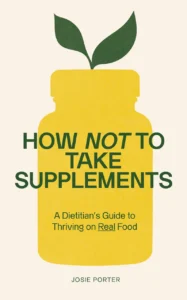
A registered dietitian specialising in weight management and women’s health. Her book, How Not to Take Supplements, is available to buy now. Connect with her on Instagram