










Most runners know the feeling: a little ache that doesn’t seem worth worrying about, until it starts getting worse. But how do you know when a niggle is something more serious – and when should you stop running?
Jessica Ennis-Hill knows all too well how quickly an injury can derail a season. In 2008, just two months before the Beijing Olympics, scans revealed three stress fractures in her right ankle, forcing her to withdraw from her first Games.
“I just felt so, so broken, so heartbroken,” she recalled. “I thought that this was going to be my first Olympics, I was so excited, so ready to do it. And then in an instant, it was just taken away from me.”
The injury didn’t end Jessica’s career. With the help of sports physio Alison Rose <internal link>, she returned to win World Championship gold in the heptathlon the following year.
Rest first, rebuild second
So, what can recreational runners learn from Jessica’s comeback – and how can you tell when that niggle needs more than a stretch and a few days off?
“After a stress fracture, it’s important to rest completely to let the bone heal,” Alison explains. How long depends on the severity or grade of the injury. “While Jessica was non-weight bearing, we worked all the other areas of her body that we could, from the shoulders to her knee and other foot, so that she could come back strong,” Alison adds.
Low-impact cross-training (think aqua jogging) helped to bridge Jess’s return to ‘normal’ training. “We had to juggle and monitor all of her disciplines as they all load the feet in different ways, and we needed to keep an eye on the overall load,” Alison explains.
Stress fractures are common in runners and track athletes, accounting for around one in five injuries. The feet and shins are particularly vulnerable. “Stress fractures are usually caused by overloading the bone over a period of time,” Alison explains. “They can also happen if someone does too much too soon, because the bone doesn’t have time to adapt, or if the bone is overloaded because the muscles aren’t strong enough to absorb the impact.”
Take it slow
If you’re new to running, or returning from injury, it’s important to build (or rebuild) your training volume safely. “As a general rule, volume (distance) should not increase by more than 10% a week, and you should not increase volume and intensity at the same time,” says Alison. “You should also be able to hop pain-free as a basic starting point.”
How do we distinguish a ‘normal’ niggle from something more serious, like a stress fracture? “Normal niggles generally warm up and go away,” says Alison. “They shouldn’t last longer than a few hours after exercising. More serious injuries get worse and worse and don’t respond to stretches. Night pain when you are lying in bed is a big warning sign.”
If alarm bells are ringing, don’t push through: stop and book an appointment with your GP or a qualified physio for a diagnosis.
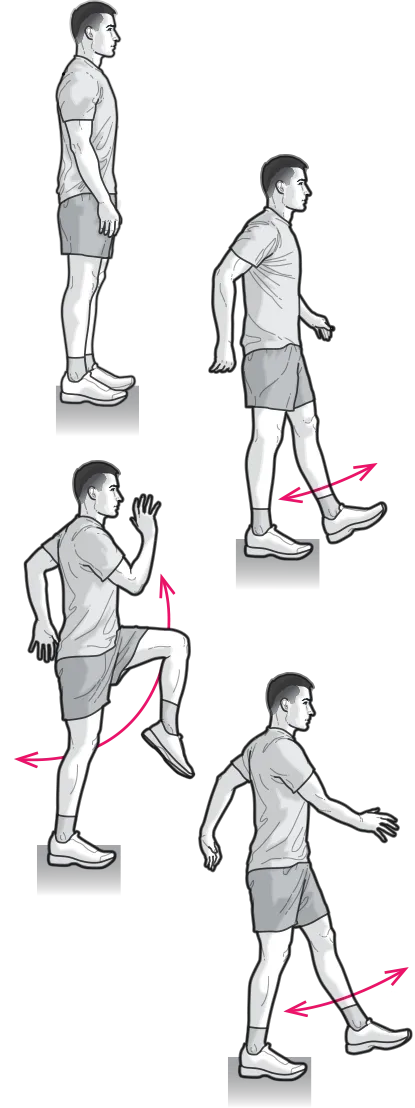
Leg swings on a step
This easy drill will help to identify and correct co-ordination and balance problems.
01 Stand tall with one foot on the edge of a step. Keep the toes on this leg relaxed.
02 Swing the hanging leg backwards and forwards, moving the arms in opposition.
03 To progress, bring the knee up in front of you as if you are running.
04 Continue for 30 seconds, then swap.
Alison says: “A very simple but excellent exercise that covers many bases for anyone who runs or walks!”

Jessica Ennis-Hill
One of Team GB’s most successful athletes, Dame Jessica Ennis-Hill is an Olympic champion and three-time world champion heptathlete. Listen to the Gold Minds podcast