










Training for peri-menopause is about strengthening the foundations before the symptoms show up. “I always say menopause shouldn’t be a wake-up call; it should be something we actively prepare for,” says women’s health coach Kate Rowe-Ham. “Starting in your thirties or early forties means you’re building muscle, improving bone health, supporting your metabolism and giving your body the tools it needs to handle the hormonal shifts that come later. The earlier you start building habits around movement, strength, recovery and nutrition, the smoother your transition will be.”
Shift your mindset
Treat perimenopause as an opportunity to reframe your relationship with movement. “I used to think training was about burning calories, staying lean or being disciplined,” says Kate. “But during peri-menopause, I realised it’s about building a body that supports me for the rest of my life. I started focusing on longevity, energy, strength and mental resilience. I trained with more compassion and more curiosity, and stopped chasing perfection. It’s an entirely different relationship with movement now.”
“Movement became my anchor when I felt like everything else was shifting,” Kate adds. “Exercise helps with mood, anxiety, brain fog, and sleep. It also gives you a sense of control in a phase where you can often feel like things are happening to you. You don’t need to go hard, just move consistently. The mental shift that comes with lifting weights or walking in nature in incredibly powerful.”
Movement became my anchor when I felt like everything else was shifting.
Strength and power
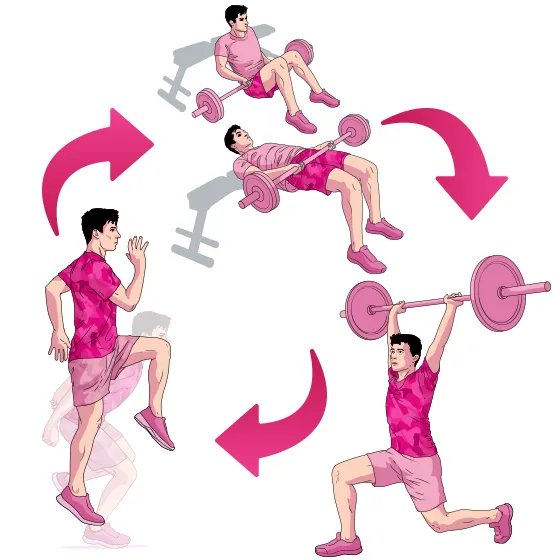
“Strength training is non-negotiable in this phase,” Kate emphasises. “It protects bone density, builds muscle (which supports metabolism and hormone regulation), improves joint stability and enhances balance.” If you’re brand new to it, start small. Bodyweight exercises like squats, push-ups or resistance bands are a great entry point. Then gradually introduce light weights with good form. It’s never too late to start – and the sooner you do, the more empowered you’ll feel.
“Power training, which involves moving with speed and intent, helps us maintain fast-twitch muscle fibres, which we lose as we age,” she adds. “That matters for things like balance, agility, and fall prevention. You don’t need to jump into anything high-impact – a simple way to start is by adding tempo to your strength work, controlled lowering, and faster lifting. Short bursts, like step-ups or medicine ball throws, can also be brilliant.”
Rest and recover
The biggest mistake Kate sees? Doing too much of the wrong kind of training – overdoing the cardio – while ignoring strength and skipping recovery. “We’ve been conditioned to believe more effort means better results, but in peri-menopause, that often backfires,” she explains. Don’t be afraid to lower the intensity. “Walking daily is a game-changer, a low-stress, steady movement that supports heart health and mental clarity. A couple of shorter HIIT or sprint sessions a week can also be great, but they need to be dosed appropriately. What served you in your twenties may not serve you now, so permit yourself to evolve.”
The second mistake is not listening to your body’s cues. “Rest and sleep are just as powerful as reps and sets,” says Kate. “If your sleep or energy is off, it’s okay to scale back. The key is tuning in to your body and avoiding the trap of thinking more is always better.”
Rest and sleep are just as powerful as reps and sets.
The third? Going it alone. “Support and community make such a difference,” she adds. If you struggle to motivate yourself, join a class or find a workout buddy.
It’s all about training smarter, not harder. “There are so many misconceptions. That we can’t build muscle. That our metabolism is doomed. That high-intensity workouts are the only answer. The truth is, our bodies are still responsive,” says Kate. “We just need to train differently. This is not the end of your strength; it’s the beginning of training with more purpose and wisdom. And it’s not about shrinking. It’s about growing stronger from the inside out.”
Train to thrive in perimenopause with Kate’s three-stage plan
 Build your foundation. Two to three strength sessions a week, regular walking, one or two sessions of low-impact cardio or intervals, plus mobility and recovery. Consistency, not perfection.

Start fine-tuning. Keep strength training at the core, add in power elements, prioritise rest, watch stress load, support recovery with walks, yoga or breathwork. Two to three strength sessions, walking most days, and one short interval session are plenty.
 Train with intention, not intensity. Two strength sessions per week, walking daily, one power or HIIT-style session if energy allows, generous recovery. Sleep, stress management, and nourishment matter just as much as training. This is about staying firm, steady and joyful in movement.

Kate Rowe-Ham
is the author of Owning Your Menopause. Follow her on instagram @katerh_fitness, and visit owningyourmenopause.com