









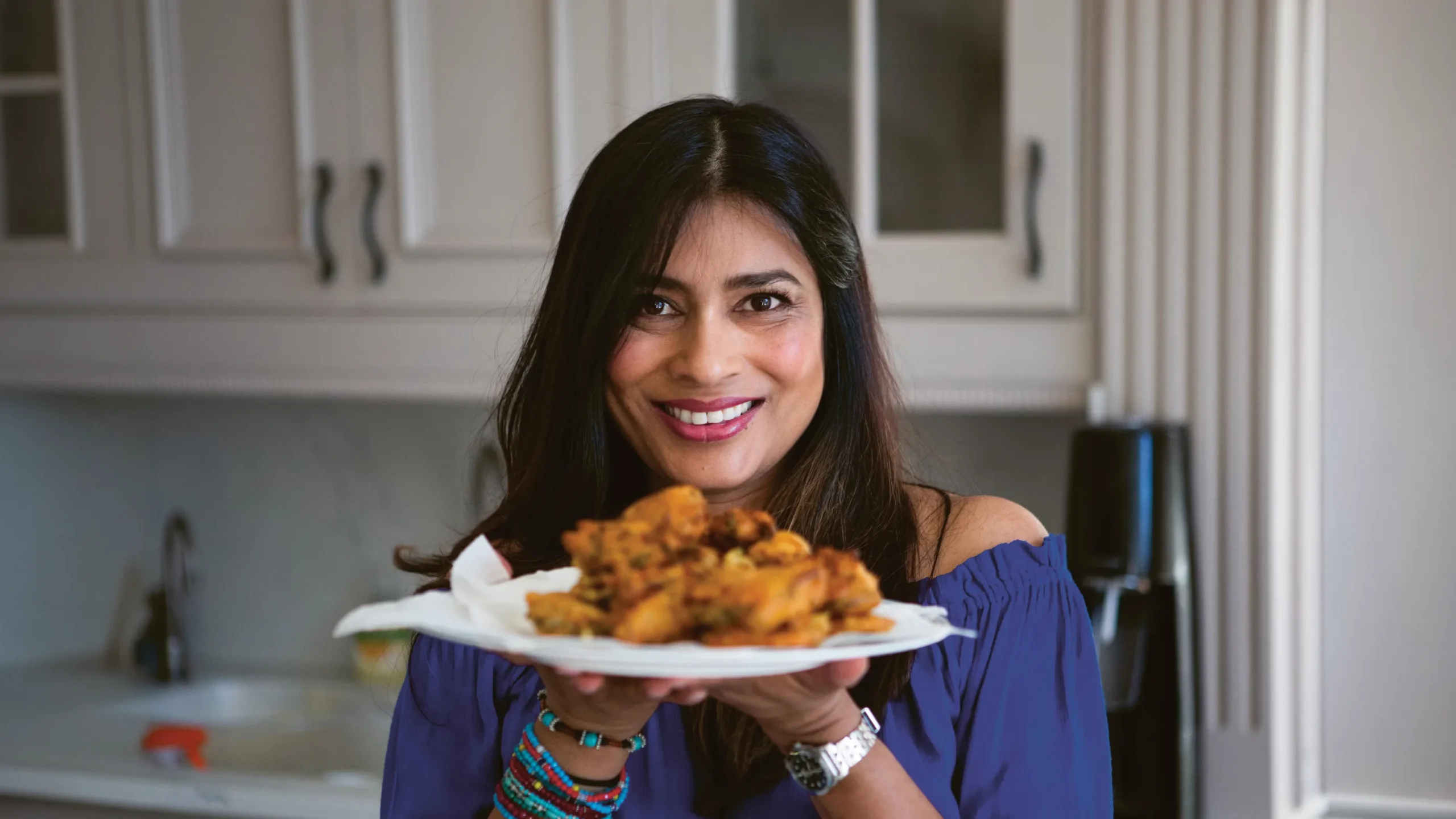
From the courtroom to the kitchen, Nisha Katona has taken a rather unconventional route into food. A former child protection barrister, she began teaching Indian cooking at weekends, determined to preserve the homestyle Indian recipes she feared might disappear with her parents’ generation. After swapping the courtroom for the kitchen, Nisha built Mowgli Street Food into a restaurant empire. Along the way came cookbooks, TV appearances and a judging seat on Great British Menu.
Yet Nisha’s food philosophy remains refreshingly uncomplicated: fresh ingredients, big flavour and food that doesn’t take all day. She champions fresh ingredients, vibrant spices and simple, comforting recipes. Here, she discusses the ingredients she always reaches for, feeding a family, finding joy in food and why, when it comes to cooking, simple is best.
You previously worked as a barrister – what prompted the shift into food?
I realised that once my parents’ generation were gone many recipes would go with them, so I used to teach Indian cooking every weekend. I realised how much people loved the homestyle dishes I was cooking and that is when the entrepreneurial thought overtook me – what if I created an eatery based on those dishes?
You champion traditional Indian ingredients – which do you return to again and again, and why?
Every recipe is predicated on three spices. Two of those spices never change, so turmeric and chilli powder go into every curry – to the point that, if you ask an Indian mother for a recipe, she won’t even bother citing those two spices. Garam masala is the recurring spice in any meat dish, and cumin seeds are a common spice in vegetarian and dishes and pulses.
Do we underestimate the healing power of food?
We absolutely underestimate the healing power of fresh ingredients, and the damaging power of ultra processed food. Food is what goes into our bodies and creates the cells that make us work or make us dysfunctional. Understanding what unnatural chemicals and additives in your food are doing to you is absolutely crucial. The one mission in my life is teaching people how to cook simply with fresh ingredients, dishes that take about 20 minutes but feed you in every way.
Has your Crohn’s diagnosis reshaped how you think about food and wellbeing?
Crohn’s disease had me staring down the barrel of my own mortality. It absolutely focuses you on what you are putting into your body. When you have looked at your own mortality so sharply you get a real perspective on what matters in life and your health – your family and your peace are everything
Interestingly, almost every specialist I spoke to said food makes no difference at all to Crohn’s once it starts to affect your gut. I’m not sure I believe that, but that is the medical opinion. I cook very healthily anyway so it didn’t change the way I cook.
I wake up thinking about what I’m going to eat, and as I’m finishing one meal, I’m planning the next. I absolutely love to eat…
How can food become a source of support for someone recovering from illness or managing a chronic condition?
When you are at your worst, your body tells you what it wants to eat, and the most important thing is to listen to it. If all you want is rice and broth, then just eat that, listen to your body and rest. It got to the point where I was too unwell to stand and cook and was surviving on rice cakes and mint tea for days. Rest, find peace, heal and then slowly start to cook things that are simple and good for you.
What is your go-to dish when you need comfort or restoration?
Homestyle chicken curry cooked with chicken on the bone. It basically has a bone broth base because you’re cooking with the marrow, but added to that you have really anti-inflammatory ingredients like ginger, turmeric and black pepper.
Did becoming a mother influence your approach to food?
Because cooking has always been my passion, it necessarily uses real ingredients. As a result, my children were weaned on home-made food, spices and every kind of flavour you can imagine. For me, the breadth of what they eat is really important. There was not an option to be picky as they were bombarded with flavour from infanthood. They need to be able to eat the world and appreciate it because that’s how our holidays become magical. We travel the world to eat.
How do you avoid slipping into restriction or fear around food?
If I’m honest, I have no concept of restriction or fear around food. I wake up thinking about what I’m going to eat, and as I’m finishing one meal, I’m planning the next. I absolutely love to eat. I love to talk about food and I love to write about food. I am such a greedy cow! It’s such an easy way to graft joy into your life, opening the fridge and in 25 minutes creating a pan of something delicious that will feed a table full of people.
Are you someone who enjoys sport or movement?
What is so awful about me is that I don’t love exercise. I like to horse ride but that means plodding around, and I like to walk the dogs if the weather is nice. During Covid, I got really into cycling and walking, but those passions did not stay with me. My parents didn’t exercise either, apart from gardening or going round ASDA! I realise that that is a real problem. It’s so important to see parents who enjoy sport and movement. I am extremely active in my work and all I do day-to-day but I’m yet to find that sport I love – I’m working on it, I promise! I want to learn how to shuffle dance – there you go!
Do you ever think about food in terms of injury prevention or recovery?
I absolutely think that the spices I’m using in the Indian kitchen are great anti-inflammatories and to some extent are therefore great for recovery. Having the right levels of calcium, fat, fibre and vitamins is something I think about for every meal that I cook. Vegetables and fruit are important – I always try to pile as many chopped veg into my curries as possible. They are hidden well or celebrated beautifully!
If you had to sum up your approach to cooking in one word, what would it be?
Simple – it has to be simple to create the food that will sustain you or you won’t persevere.
Nisha Katona
CEO, executive chef and development chef of Mowgli Street Food restaurants and founder of the Mowgli Trust charity. She is the author of seven cookbooks. Her latest book, The Curry Bible, is available to buy now.