










Premier League physio Marc Mulligan knows from experience that strength is key to optimising performance and reducing injury risk, whatever your sport. Here, he shares two simple warmup circuits designed to boost power and resilience and reduce injury risk. “Key muscle groups for footballers are the hamstrings and adductor (groin) muscles,” says Marc.
“These are the most frequently injured muscles and therefore good mobility and strength are key to preventing injuries. Strengthening trumps mobility in injury prevention so these are key. However, they are tough exercises so may need to be built up to, depending on the athlete. In terms of generic strength, all grassroots players should competent in: squats, split squats and stiff leg deadlifts.”
CIRCUIT A

Single Leg Arabesque
1 Stand tall with your feet hip-width apart. Shift your weight onto your left leg, keeping a slight bend in the knee. Extend your right leg straight behind you while hinging forward at the hips, reaching both hands towards the floor in front of you.
2 Maintain a neutral spine and keep your hips square to the floor as you lower your torso and lift your back leg, forming a straight line from head to heel.
3 Engage your glutes and hamstrings of the standing leg to stabilise your balance.
4 Pause briefly at the bottom, then drive your hips forward to return to the starting position with control.
5 Complete all reps on one leg before switching to the other side.
Perform 2 sets of 8 reps per leg
MARC SAYS “Single leg arabesques improve hamstring and glute strength, enhance balance, and develop hip hinge mechanics essential for lower body stability and injury prevention.”

Nordic hamstring exercise
1 Kneel on a soft surface with your knees about hip-width apart. Have a partner hold your ankles down firmly or anchor your feet under something sturdy.
2 Keep your body straight from knees to head, engaging your glutes and core. Cross your arms over your chest or hold them by your sides.
3 Slowly lower your torso towards the ground in a controlled manner, resisting the movement with your hamstrings. Go as far as you can before losing control, then catch yourself with your hands.
4 Push lightly off the floor to assist the return, or use assistance bands if needed, and return to the starting position.
Perform 3 sets of 5 reps
MARC SAYS “Nordic hamstring exercises strengthen the hamstrings eccentrically, helping to prevent injury, improve sprint performance, and build resilience in the posterior chain.”

Counter-movement jump
1 Stand tall with your feet shoulder-width apart, arms relaxed at your sides.
2 Quickly dip into a quarter squat by bending your knees and hips while swinging your arms back to load energy.
3 Explosively jump upward as high as possible, swinging your arms forward and upward to generate momentum.
4 Land softly with knees slightly bent, absorbing the impact through your hips and knees, then reset for the next rep.
Perform 3 sets of 6 reps
MARC SAYS “Countermovement jumps develop lower-body power, improve explosive strength, and enhance athletic performance in activities like sprinting, jumping, and change of direction.”
CIRCUIT B

Lateral Lunge
1 Begin in a straight arm plank, with ankles, knees and shoulders in a straight line.
2 Keeping abs and glutes engaged, slowly walk your hands backwards as far as you can safely.
3 Once you’re standing straight then return to first step.
Perform 2–3 sets of 8–10 reps per side
MARC SAYS “Lateral lunges build strength in the glutes, quads, and inner thighs while improving hip mobility and lateral stability.”
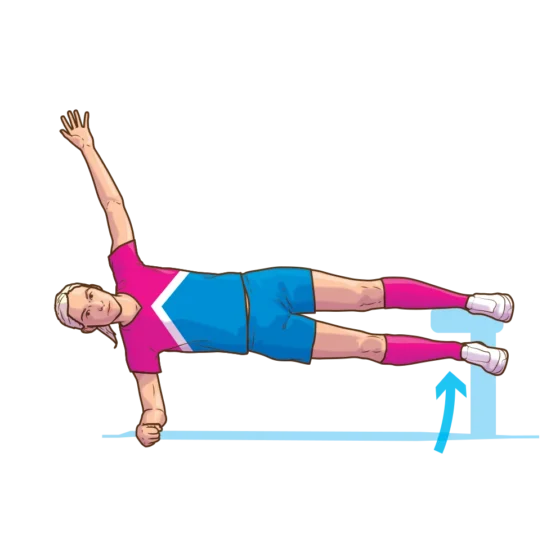
Adductor – Copenhagen Plank
1 Begin in a straight arm plank, with ankles, knees and shoulders in a straight line.
2 Keeping abs and glutes engaged, slowly walk your hands backwards as far as you can safely.
3 Once you’re standing straight then return to first step.
Perform 3 sets of 30 second holds
MARC SAYS “Copenhagen planks target the adductors, improve hip stability, and strengthen the core and inner thigh muscles, making them highly effective for injury prevention and athletic performance.”
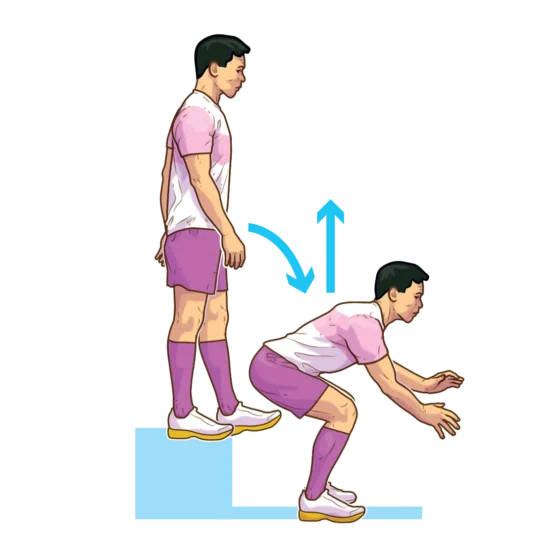
Drop Jump
1 Stand tall on a sturdy box or step, about 20–40 cm high, with your feet hip-width apart and toes pointing forward.
2 Step off the box by dropping straight down – do not jump up or forward.
3 Land softly on the balls of your feet with knees slightly bent, hips back, and chest up, ab- sorbing the impact through your legs..
4 As soon as you make contact, immediately rebound into a vertical jump, driving through your ankles, knees, and hips.
5 Land softly again and reset for the next rep.
Perform 2–3 sets of 5–8 reps
MARC SAYS “Drop jumps improve reactive strength, explosive power, and lower limb stiffness, enhancing performance in activities requiring quick changes in direction and jumping ability

Marc Mulligan
Marc is a specialist musculoskeletal Physiotherapist based at Complete Physio in London. He has extensive experience in professional football, working for West Ham United FC, Charlton Athletic and Leyton Orient FC.