










 “I’ve just come from the pitches where we’ve been cutting the grass,” began Paul Smith, coach and founder at Boldon Girls FC. It’s been more than 30 years since Paul started the club at the age of 35, when an injury put an end to his playing days. That he is prepared to operate a lawnmower in 30°July heat is a sign of his continued dedication. “The council only cuts it when the grass is really long so we need to keep on top of it.”
In his job as a youth worker, Paul saw how football could be an effective tool even with kids he described as “workie tickets“. So he signed up to do his coaching badges – which he completed alongside former England international Paul Bracewell – and set up a street league in the hope of integrating girls and boys. But he soon encountered some rigid ‘90s norms.
“We had a few girls interested but the lads wouldn’t let them play. So I decided to set up a girls-only session.” In 1992, Paul registered Boldon Girls with the FA but there were no local leagues in which to play. “I had to hunt out teams and we had to travel to places like Sheffield,” remembered Paul. “We even went as far as London to play a game.”

“We had a few girls interested but the lads wouldn’t let them play. So I decided to set up a girls-only session.”
PAUL SMITH
What began by scraping together one team of defiant girls has grown into a brimming stable of 14 squads ranging from under-7s to under-15s. “We’ve recently lost our under-18 team because they’ve all moved on to academy teams,” said Paul. “Some have gone to Newcastle, one to Middlesborough. Which is good, we would never hinder their progress.”
It’s a scenario that Paul is so familiar with that he has a scrapbook that serves as an origin story for some of the country’s leading Lionesses. Steph Houghton and Demi Stokes are among the internationals who played at Boldon, and Lucy Bronze also played under Paul during his time managing an England team representing the Association for Boys and Girls Clubs. “I selected Lucy when she was playing for Blyth. Technically, she got her first England cap with us.”
Paul remembers that half of his original Boldon team went on to play for Sunderland. Among them was Jill Scott. “Jill could run and run. At 13 she had a decision to make. Sunderland Harriers wanted her as she wasn’t far from being an England runner,” said Paul.
Jill chose wisely, not only going on to captain her country and win 161 caps but also lift the European Championships in 2022. The two remain in touch. “Jill texted me the other day, I’m like her second dad. She played for me from the age of nine right up until she was 17. When Sunderland signed her they said she couldn’t play for us. But she told them, ‘If I can’t play for Boldon then I won’t play for Sunderland!’”
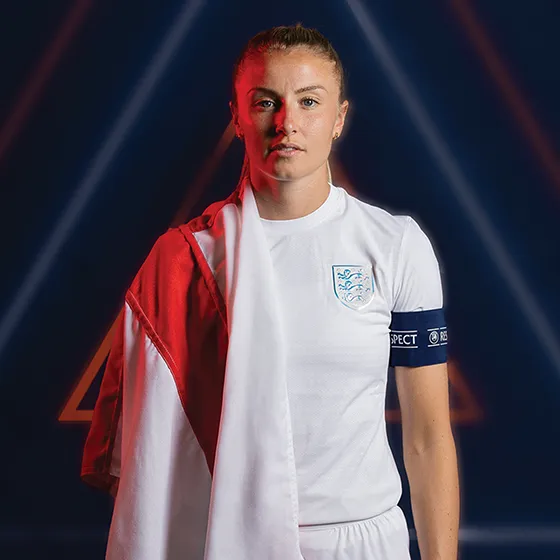
Earlier this summer, Cadbury launched a Game Changing Wins campaign, backed by current England stars Leah Williamson and Lauren James, alongside Jill. They were each asked to nominate their personal game changer. “Lauren picked her brother Reece, Leah picked her grandmother and Jill picked me,” recounted Paul, smiling as he told of a chauffeur-driven day filming in London. Paul got the opportunity to show Jill his scrapbook and share some memories. “If anyone scored a hat trick I used to sub them off to give the other kids a chance. There were a few times I brought Jill off and she’d shout ‘I’m not playing for you anymore!’. I made sure to remind her of that.”
Slick national ad campaigns and high-profile brand endorsements are a far cry from Paul’s first experiences of girls’ football and he’s proud of the pioneering role his club has played in changing attitudes. “I remember one day I asked a referee friend to officiate and he said, ‘I’m not refereeing lasses’. But when he saw them he was amazed. Eventually, people started realising that some of the girls are actually better than the lads.”
“I remember one day I asked a referee friend to officiate and he said, ‘I’m not refereeing lasses”
PAUL SMITH
As for Jill, she’s never been shy about lauding her former club and mentor. “I don’t think I’d have gone on to play for England without Paul,” she said. “I got told at the age of nine that I couldn’t play with the boys anymore. I had to go and find a girls’ team. That was when I found Boldon and met Paul Smith.
“Paul used to pick me up and take me to training. Those are my happiest memories, getting up early on a Saturday, playing football, travelling around with the girls having such a laugh.”
Boldon’s pedigree for nurturing talent means there are few issues with recruitment, “We don’t advertise for players, they just seem to come,” said Paul. But these levels of enthusiasm aren’t always matched in other areas. “The problem we have is getting people involved with running the teams. With a club like ours, you’ve got to have meetings and committees. And we need volunteer trustees to help with safeguarding, for dealing with the FA, and for working with the leagues.”
As it is for many grassroots organisations around the country, venues and finances are a continual headscratcher for Boldon. Paul has considered applying for charity status to help with the latter, while the former relies on the goodwill of South Tyneside council. But it’s jarring to discover that his main concern is the community’s dwindling support. Cost-cutting local authorities may be the default grassroots bogeyman but Paul suggests that this risks overlooking a growing problem closer to home.
“It’s become harder since the pandemic. Last year, I was doing two teams as nobody else would take it on. I can’t even get some of the parents to put the nets up,” he said, noting that the rise of WhatsApp groups have had a negative effect on real-life interactions. “Some parents drop the kids off and sit in their cars. I’m 70 this year. Who’s going to take the reins when I go?”
Paul has considered winding down his involvement for several years but Boldon’s current crop will be relieved to know that he finds it too hard to walk away just yet. “I’d miss the kids. Me being a youth worker, I’ve been able to work with hard-to-reach kids. You get a buzz as you see them grow up.
“I’ve had teachers tell me that kids’ behaviour has been transformed at school since they started playing football. Parents tell me their child’s confidence levels have gone up, their social skills have improved, they’ve made friends for life. That’s what keeps me going.”
Breaking the Mould
Across the UK, clubs like Boldon have reshaped sport by challenging convention. Gunnersbury Women’s Cricket Club marks its centenary in 2025, a pioneer from when few women played the game. Formed in 1984, Wasps Women became one of the UK’s first non-university women’s rugby teams, launching stars like Sue Day and thriving under Giselle Mather, who later became the first woman to coach a men’s club side. In Harlow, Changing Lives FC are the UK’s first team made entirely of refugees and migrants, using football to build belonging, tackle prejudice, and give displaced individuals a voice through sport.